THE MODERN
SECURITY OPERATIONS CENTER
An engineering- and AI-led SOC, built for Eaton — where autonomous agents and human expertise operate as one.
Prepared for Eaton Corporation · 7AI

Proven in Production
The world's largest,
most successful AI SOC
"Right off the bat we've seen an 80% reduction in tier-1 analyst time. As those tickets progressed through the funnel, we've seen easily a 95–99% reduction in the tickets that human beings have to look at. Incredible outcome. We believe this is the world's largest, most successful AI SOC deployment."
80%
Less tier-1 analyst time.
95–99%
Fewer tickets reaching humans.
Scale
Largest AI SOC deployment to date.
Customer Voices
Security leaders are reinventing the SOC

"The future of cybersecurity lies in leveraging AI to not only augment human capabilities but to fundamentally reshape how security operations are conducted. This is not incremental improvement — it's a reinvention of how we protect our organization in an increasingly complex threat landscape."

"I've envisioned this for five years — AI handling the mundane alert triage so my team could focus on creative, strategic work. 7AI made it real, scaling our team's capacity 10x and freeing analysts from burnout to work on the challenges that actually matter."
Quality · Speed · Coverage
Take on more — and improve Eaton's program
Against the incumbents Eaton already knows, the conclusions match — but 7AI reaches them faster and across far more of the alert volume. That headroom is what lets us expand scope: investigate everything, raise the quality bar, and strengthen the security program rather than just maintain it.
"The stat we presented to our CIO was that 7AI fully investigated 3.5x more alerts than Red Canary."
"No discrepancies from ReliaQuest in terms of conclusions — but you're processing 10x faster."
Quality
Same expert-grade verdicts — no discrepancies.
Speed
Conclusions reached up to 10x faster.
Coverage
3.5x more alerts fully investigated — nothing skipped.
The Inflection Point
The legacy SOC
can't scale with the threat
Alert volume compounds, tier-1 analysts burn out, and dwell time stays measured in days. Adding headcount linearly against an exponential problem is a losing equation. The next SOC is not staffed bigger — it is engineered differently.
The 7AI Model
Four pillars, one operating system for security
AI
Agentic detection & response that works the alert, not just flags it.
Engineering
Detection-as-code and a platform that turns tradecraft into software.
MDR
24/7 managed service with expert humans on the loop, not the bottleneck.
Roadmap
A staged journey from co-pilot to autonomous, measured at every step.
Faster
Minutes to triage, not days.
Cheaper
Effort scales sub-linearly with volume.
Better
Consistent, auditable, every time.
Pillar 01 — Artificial Intelligence
The agentic flywheel
Pillar 02 — Engineering
The best builders, engineering for Eaton
The modern SOC runs on AI and technology — and that only works with the best people developing and building the solutions behind it. Our engineers treat Eaton's defense as a product: detection-as-code, tested in CI, continuously improved, and purpose-built to advance Eaton's security program.
Author
Detection-as-code in Git.
Test
Validated in CI against telemetry.
Deploy
Pushed across your stack.
Tune
Feedback retrains the agents.
Measure
Coverage mapped to MITRE.
AI-Native
Built on technology, not headcount.
Best-in-Class
Top engineers building for Eaton.
Program-First
Engineered to improve Eaton's posture.
PLAID ELITE / MDR
A 24/7 SOC with humans on the loop
- Humans do tier-1 triage — slow and inconsistent.
- Pay per analyst; cost grows with alert volume.
- Black-box alerts forwarded over the wall.
- SLAs measured in hours, sometimes days.
- Agents do tier-1; experts focus on decisions & hunting.
- Cost decoupled from volume — efficiency scales.
- Full transparency: see every step the AI took.
- Verdicts in minutes, escalations with context.
24 / 7 / 365
Always-on coverage, no gaps.
Elite Analysts
Senior expertise on every escalation.
Your Stack
Works with the tools Eaton owns.
Pillar 04 — Future Roadmap
A staged path to the autonomous SOC
0–90 Days
Deploy & Co-PilotFoundation
Integrate telemetry, stand up agentic triage alongside Eaton's team. AI assists, humans decide.
3–6 Months
Trusted Automation
Agents auto-close validated false positives and run containment playbooks within agreed policy.
6–12 Months
Proactive Defense
Continuous threat hunting, custom detection engineering, and exposure reduction mapped to Eaton's risk.
12 Months+
Autonomous SOCVision
The majority of the response lifecycle runs autonomously; humans set strategy and handle the truly novel.
In-House Expertise
We didn't start with a product.
We started with people.



The platform doesn't ask you to work its way. Your AI Security Engineer builds it to work yours.
Built for Eaton
Why this fits a global industrial leader
Global Footprint
Consistent coverage across every region, plant, and business unit — IT and OT alike.
IT / OT Aware
Detections tuned for industrial and manufacturing environments, not just cloud and corporate IT.
Audit-Ready
Every action logged and explainable — built for regulated, board-level reporting.
The result: Eaton's security team is freed from the alert treadmill to focus on the strategic risk decisions that protect the business.
The Day Ahead
Today’s agenda
Breakfast 8:30 AM · Working lunch 12:00 PM · Departure 3:00 PM
PLAID · Results, Adding Workloads, What’s Next
POV → Production
We showed you how, on your data, in three weeks. Now we are ready to get started.
Owners · Barry Wray · Phil Royer · Steve Lazzaro
Proof of value = partnership
In a live deployment against Eaton’s production alert stream, 7AI’s agentic investigations met the core success criteria, surfaced novel threats existing tools missed, and sharpened Eaton’s own controls.
Requests · Integrations & Capability
What Eaton asked for, and when we delivered
Into Sentinel incidents: IOA, registry keys, reaction status.
Write AI findings and recommendations as comments on the incident.
Push analytic rules to Sentinel and IOAs to CrowdStrike, not just triage.
Ingest an advisory (e.g. npm supply-chain) and hunt the environment.
Enrich with Eaton’s intel and CrowdStrike indicators.
From the auto-close-informational rule. Still investigate.
Raised as future integration targets.
Shared host-name patterns and site codes for context.
Requirements Scorecard
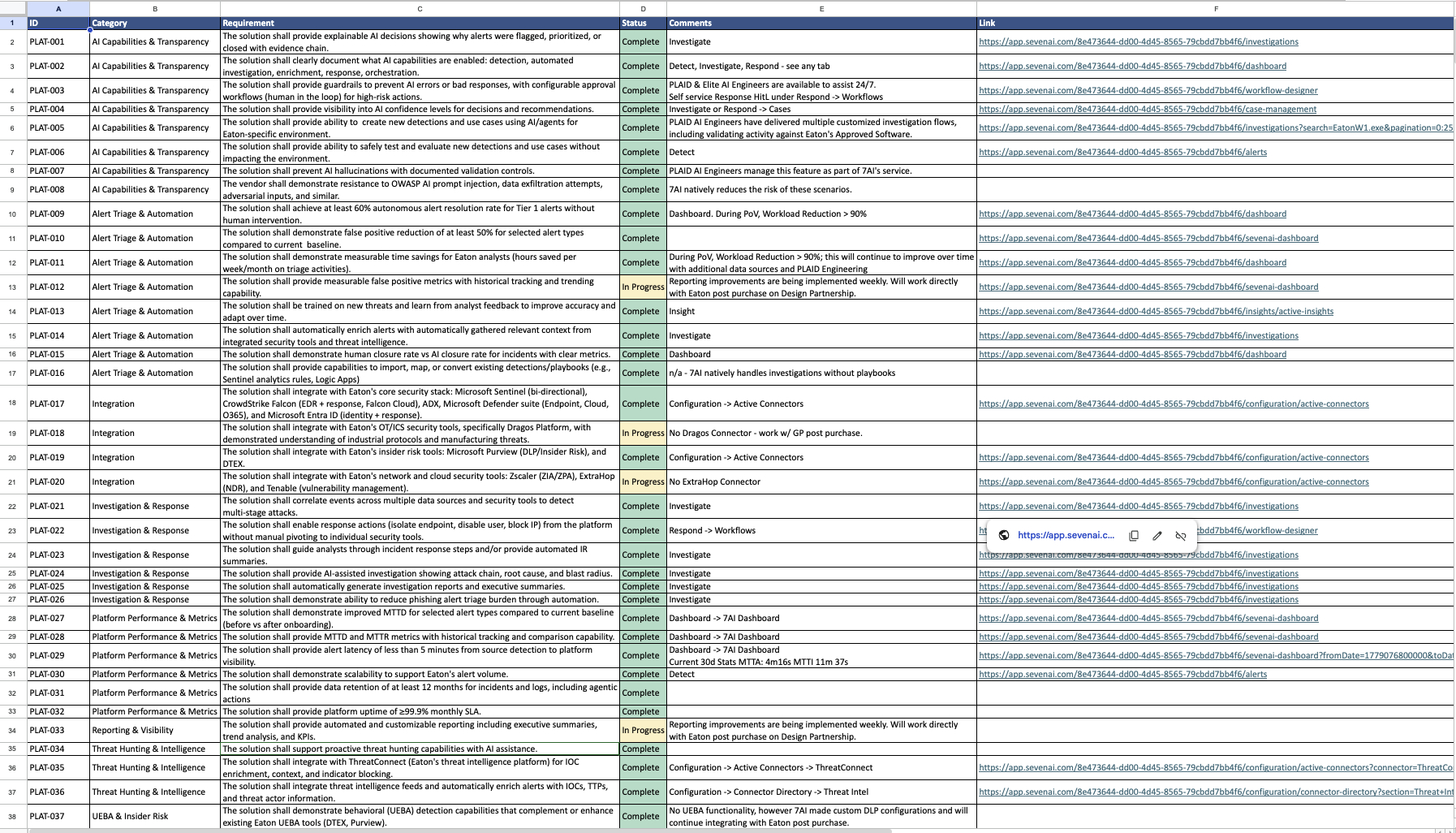
37 platform requirements, tracked
Every requirement Eaton defined, scored with status, comments, and a link to validate in their own tenant. The live scorecard was delivered to Eaton.
Where We Started
Eaton’s requirements
Close-out & volume reduction
60%+ of alerts resolved by agentic investigation. Currently at a 95% deflection rate.
Safely test new detections
Stand up and evaluate new detections safely before they reach production.
Investigation depth
Every AI investigation shows the full picture: attack chain, root cause, and blast radius.
Work with Eaton’s stack
CrowdStrike, Microsoft Sentinel & Defender, Entra ID, Purview, Zscaler all supported.
Explainable decisions
Clear, transparent reasoning provides an auditable evidence chain.
>99% uptime
Production-grade reliability across the platform.
Agentic threat hunting
Ad-hoc natural-language hunts plus ongoing IOC-based hunts in Eaton’s environment.
Enrichment as force-multiplier
Auto-enrich context across tools so analysts stop pivoting between consoles.
Insource investigations
Empower Eaton’s team to bring work in-house and use institutional knowledge.
Customizations built during the PoV
Not an out-of-the-box trial, the platform was shaped to Eaton.
Ingest tuning
EDR, identity and Purview ingestion shaped with autosuppress rules hand-selected to keep the queue on real signal.
CrowdStrike → Sentinel mapping
Underlying alerts mapped across incidents so the AI reviews every layer, not just the wrapper.
Identity tuning
Impossible Travel, MFA and Insider Threat streamlined to cut investigation noise.
Privileged accounts
Eaton’s admin naming convention (adminC, adminE, …) taught to the engine so privileged-identity activity is recognized and weighted.
Zscaler response action
One-click URL block wired through Zscaler for automated containment.
PUP & benign tools
Eaton’s approved-software spreadsheet, Falcon Sandbox detonation, and custom reasoning together clear PUP and benign-tool noise.
ThreatConnect connector
Built and tuned to Eaton’s custom threat-intel data sources.
Production cutover
Validated in staging, then promoted to production.
7AI found what EDR could not
An agentic threat hunt in Eaton’s environment surfaced CRXfiltrate activity that endpoint tooling did not flag. Novel-threat discovery is the difference between signature-bound tooling and agentic hunting.


Real investigations from Eaton’s data
Impossible Travel
China–US sign-ins hours apart for one user. The AI ran IP reputation (Spur, VirusTotal, IPinfo), found the US endpoint was clean satellite internet (ViaSat), and resolved benign instead of escalating noise.
View investigation… and 39 other Identity FPs
Developer PowerShell
powershell.exe from System32, launched by VS Code and Visual Studio dev shells running local test scripts, no encoded commands, IEX or downloads. The AI confirmed benign developer activity and closed it.
View investigation… and 2,302 other EDR FPs
DigitalOcean sign-in
An unfamiliar sign-in from DigitalOcean datacenter hosting, nine failed attempts, blocked by Conditional Access, on an unmanaged device. With the risk unresolved, the AI escalated for human review.
View investigation… and 384 other escalations
Confident false-positive closes reduce noise; genuine uncertainty escalates to a human. The platform never guesses silently.
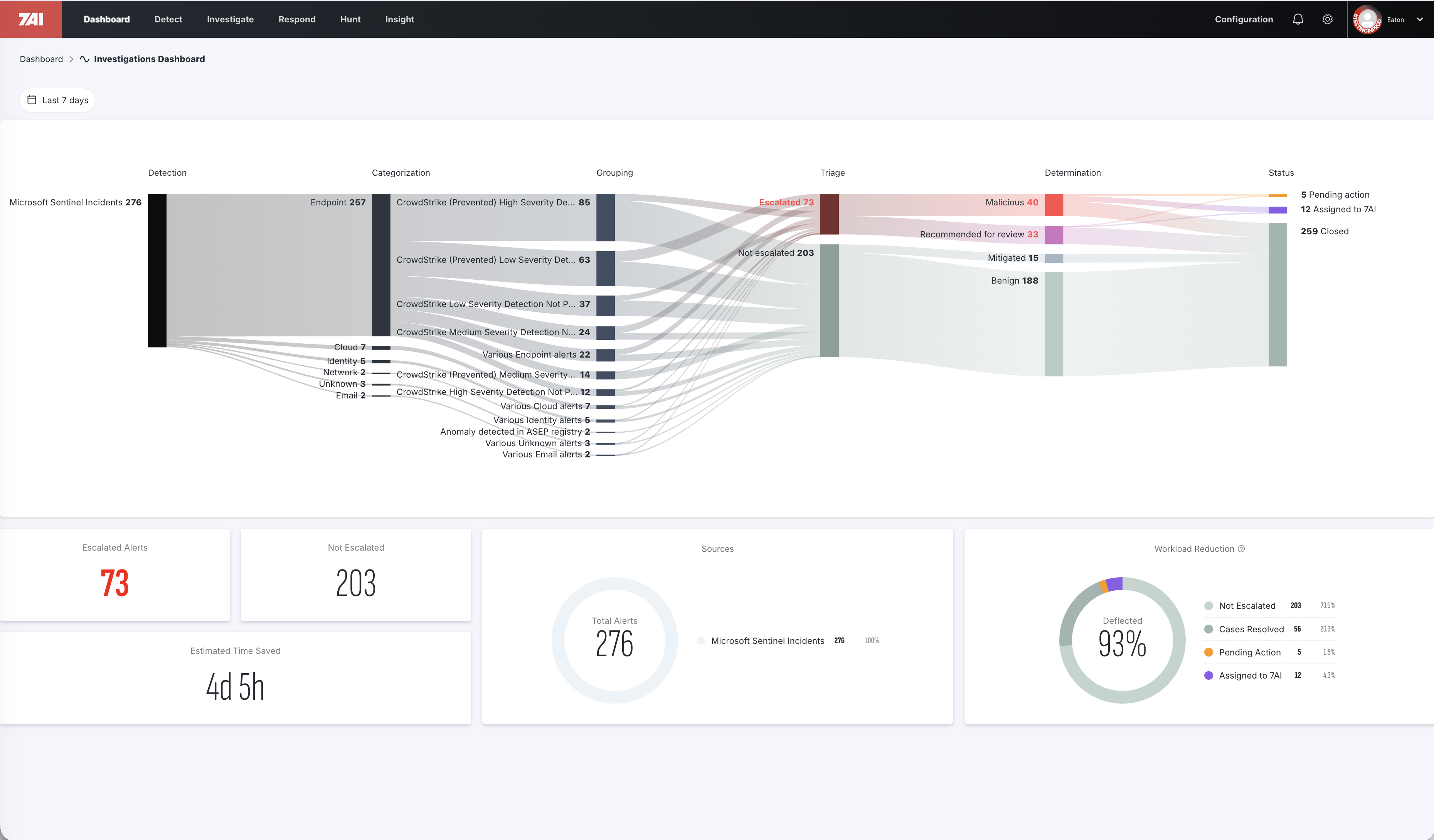
Machine speed and scale enables your team
Control
Eaton’s analysts stay in control. Our experienced engineers customize the agents to your business needs.
Trust
Every determination ships with its evidence chain, conclusions you can audit and trust.
Speed
The platform triages, investigates and responds quickly, saving time and reducing risk.
Where we go from here
The PoV met its bar. The recommendation is to move to a production partnership and close the open integration items.
Confirm success criteria
Confirm the 40%+ volume-reduction target and explainability bar against Eaton’s own review.
Full coverage
Stand up remaining connectors: enrichment feeds, Purview depth, and the Dragos / ExtraHop path.
Graduate to write actions
Move from read-only to gated, human-approved response on agreed alert types, at Eaton’s pace.
Operationalize
Lock the PLAID ELITE 24x7 model, assigned engineers, and the multi-year path with GuidePoint.
Coverage & Expansion
From POV scope to full coverage
June 17, 2026What we cover · what's next
MSSP parity
- Sentinel Custom (NCI/GOV)
- Falcon Recon
- Checkpoint IPS
- Zscaler DLP / Web
MS-native + insider
- Cloud App Security (MCAS)
- Defender for Cloud
- Identity Threat (AD ATP)
- DLP / Data Exfiltration
Specialized
- CC_AI-DSPM (Copilot/AI)
- Dragos OT / ICS
- ExtraHop NDR
- DTEX · UEBA
What 7AI runs now
Prod, 14 days: ~708 Sentinel incidents auto-investigated, 86% closed without an analyst, 16% malicious.
CrowdStrike Detections
Prevented & not-prevented EPP/IDP/XDR/Cloud-IOA detections, the dominant alert family. Full autonomous triage with process-lineage, VT and approved-software enrichment.
Defender ATP
Microsoft Defender for Endpoint, credential-theft, malware, suspicious Office/script behavior, investigated alongside the CrowdStrike signal.
Identity Protection (AAD)
Entra ID risk, impossible travel, unfamiliar sign-in, password spray, privileged-role change. Routed to the identity investigation plan.
Purview IRM
Insider-risk data-leak issues, investigated via Engine V3 on the custom Purview Console connector built during the POV.
MSSP parity
The four buckets Eaton's MSSP works that 7AI doesn't yet, admit them to the allowlist to reach parity.
Sentinel Custom (NCI/GOV)
Eaton's own analytic rules, Kerberos error-code abuse, excessive auth failures, perimeter denies, GOV-tagged alerts. Largest single expansion; requires relaxing the GOV-drop rule.
Falcon Recon
Exposed-credential, typosquatting, VIP-mention and criminal-marketplace intel across Eaton/Souriau/Fibrebond. Mostly "unactionable", pair with a low-cost enrich + auto-close plan.
Checkpoint IPS
Check Point IPS high-severity alerts. Low volume, cheap to admit, a straightforward parity win.
Zscaler DLP / Web
Web & DLP events, the Zscaler ZIA connector is already wired, so enrichment depth is there from day one.
Inside Sentinel Custom (NCI/GOV)
671 incidents / 14d across 10 of Eaton's own analytic rules, 95% auto-closed by the MSSP today, none autonomously investigated.
Why it's the #1 expansion
- 95% auto-closed by the MSSP, no analyst eyes, no autonomous verdict today.
- Kerberos abuse (T1558.003) = 74%, classic Kerberoasting signal, all Medium.
- Eaton custom rules (product Azure Sentinel), invisible to the CrowdStrike/Defender feeds we run now.
- YARA change: add
NCI:/Eaton: NCIto the allowlist + relax the GOV-drop.
Microsoft-native + insider
Telemetry Eaton already feeds 7AI directly, onboard the plans to cover it.
Cloud App Security
SaaS session anomalies, OAuth abuse, personal-account setup. Suppress the Eaton-auto-closed noise, investigate the rest.
Defender for Cloud
Azure workload alerts, storage exfil, Cosmos DB key extraction, VM script abuse. Keep the IP-baseline auto-close as a suppress so only real alerts run.
Identity Threat (AD ATP)
Defender for Identity, pass-the-hash/ticket, AS-REP, recon against on-prem Active Directory. Complements the AAD coverage already live.
DLP / Data Exfiltration
Sensitive-file sharing, local email collection, webmail egress, the data-movement signal that pairs with Purview IRM.
Specialized telemetry
Full-coverage round-out, OT, network, AI-risk and behavioral sources.
CC_AI-DSPM (Copilot/AI)
Prompt-shield jailbreaks, AI-app anomalies, prompt-leakage, Copilot misuse, a net-new, executive-visible risk domain.
Dragos OT / ICS
Operational-technology detections for the plant floor. Suppress the cert-reissue / uptime noise, investigate the real OT threats.
ExtraHop NDR
Wire-level network detections, lateral movement, beaconing, protocol anomalies the EDR can't see.
DTEX · UEBA
High-risk-user scoring (DTEX) and behavioral priority (UEBA), corroborating signal that sharpens insider-threat investigations.
Engine V3
The autonomous investigation engine now running your alerts, from a one-step false positive to a multi-stage threat, every verdict reasoned end-to-end and backed by evidence.


Session 03 · AI Vision
AI Vision
Tanner’s AI vision.
Our AI Vision
One closed loop, not a pile of point tools.
Security operations is one continuous loop, but most tools own a single stage and leave you the seams between them. Our vision: run the entire cycle as one system, with AI agents at every stage drawing on knowledge and practices encoded by elite security engineers.
One engine. Many modules.
We didn't build a separate AI system for triage, another for hunting, another for chat. That's the legacy trap, and it's prohibitively expensive. We built one engine (Engine v3) and express each capability as a module. As the engine improves, every module wins.
New AI capabilities in weeks, on one engine.
- A new agentic use case = a Module + Skills + a frontend. The engine provides the hard parts (memory, durable state, recovery, live streaming) for free.
- Proof: Threat-Intel Hunting, a brand-new product, was built as a module and running end to end in about a month.
- A production chat interface is under ten lines of code for a module owner. The platform handles the plumbing.
- Every module that ships makes the engine better, and every engine improvement lifts every module.
This is an architecture choice that compounds, not a feature list. A new capability is weeks of work, not a new system.
Purpose-built for how AI understands and accesses data.
Legacy security tools were built for people: dashboards to read, query languages to type, schemas to memorize. Bolt AI on top and it inherits a human-shaped world it has to translate. AI-native means the opposite: we build the data layer, the connectors, and the way data is described and reached for how an AI actually works.
Data that knows what it means
Fields, entities, and relationships are modeled so the AI reasons over meaning, not raw rows. It understands your environment, not just queries it.
Reached the way an agent works
The AI gets to data by intent, across every tool, querying where it lives, not through the consoles and syntax built for a person.
When the systems around the AI are built for the AI, it spends its effort investigating, not translating.
It works the case like a senior analyst: one hypothesis at a time.
- Working memory is a structured picture of the case: the agent searches it by exact indicator and by meaning, the way an analyst works an evidence board.
- It chases independent leads in parallel where it helps, and it's bounded: it knows when to stop, not just when to go.
Three kinds of skill: your knobs to turn.
Shapes the query
How to query a given tool (Splunk SPL, Sentinel KQL), matched to each step.
Adds capability
Enrichment tools the agent can call: reputation, sandboxing, lookups.
Shapes the plan
Investigation methodology, injected at planning. Where your team encodes how an analyst should approach a case.
Bring your own skills. Your playbooks steer the plan itself, not just the query. The SME's knowledge isn't a suggestion to the model; it's wired into where decisions get made.
We own the engine, so memory and learning live in the core.
- Working memory, per investigation. Everything the agent learns becomes a structured picture of the case it can search by keyword, by meaning, and by relationship at once, not a scrolling chat log.
- It learns what works, per customer. The engine records which queries actually produced answers in your environment and reuses them. That learning never crosses tenant boundaries.
- Durable and replayable. State is recorded as it runs, so any investigation can be reconstructed step by step, or resumed if a worker dies mid-run.
A vendor wrapping a model, or bolting an assistant onto a SIEM, gets a context window and nothing else. Because we built the engine, memory and learning are first-class, not features we ask someone else's product for.
Grounded in evidence, not guesswork.
It can't bluff
A finding must point to the evidence that supports it. A claim it can't ground is flagged for review, never published as fact.
It says "I don't know"
When it's unsure or a tool fails, it escalates and routes to a human, never a silent all-clear.
It verifies
It tests hypotheses against your live data, rather than asserting from training priors.
Graded against labeled production data, not vibes.
- Validated on real production investigations, graded against analyst-labeled outcomes.
- Confidence is reported as a level, High / Medium / Low, not a false-precision score.
- Every run is replayable, so a disputed verdict can be re-examined against the exact state the engine saw.
- Humans review and feed corrections back, so the bar keeps rising.
Most AI tools ask you to trust the verdict. We grade ours against labeled outcomes, and we'll show you the grade.
Now watch it work, on a real alert.
A live Engine v3 investigation of a real Microsoft Purview data-loss alert, from the moment it fires to a grounded verdict.
- The hypothesis loop: it forms theories and tests each against real data.
- The citations: every finding points back to the evidence behind it.
- A verdict it can defend, with the response gated for a human.
Security and AI experts, pushing the frontier together.
Cybersecurity experts and AI experts in the same room, no silos. We run aggressive applied R&D, innovating on agentic AI itself (how agents reason, remember, and plan), then aiming it at security.
Build the engine
Engineers and researchers from AWS, Microsoft, MIT, and Harvard, building a novel agentic engine from the ground up, not wrapping someone else's.
Encode the expertise
Front-line defenders from Cybereason, Carbon Black, MITRE, Unit 8200, Palo Alto Networks, and SentinelOne, with decades working real incidents.
Most vendors send a sales team. You're meeting the people who build it.
Two roles, one platform, built to move fast together.
Builds the engine
- Ships core capability: streaming, memory, multi-agent orchestration.
- Benchmarks models per task (latency, precision, cost) and instruments the platform end to end.
- Exposes clean extension points so use cases ship without touching engine internals.
Owns the use case
- Authors and tunes investigation strategies, encoding analyst playbooks as versioned, testable skills.
- Replays real investigations against changes, grading against analyst-labeled ground truth.
- The customer's technical partner: cuts false positives, onboards new alert types.
The fully-closed, self-improving loop is the vision. What you saw is how the AI does the work today: it reasons hypothesis by hypothesis, cites its evidence, and gets sharper every cycle.
- Can it show its work, step by step?
- Can it cite its evidence, and say "I don't know"?
- Can you replay any decision, and shape its judgment?
- Does it query your data where it lives, or copy your logs?
AI Vision · Live Demo
Purview investigations with Engine V3
Mike shows a live Purview investigation with Engine V3, the work Eaton’s analysts spend hours on today. First investigation shown live; second if time permits.
Presenter is logged into Eaton’s environment; buttons open the live investigations. Owner: Michael Tan.
Session 05 · Product · 12:30 PM
Product Update
Near and mid-term roadmap (the Q2 / Q3 timeline Grace and John asked for) and agentic reporting, the piece John and Grace were most interested in. Shown in demo.
Open the Product Roadmap →PLAID ELITE
PLAID ELITE
AI speed and scale. Human trust.
Owners · Israel Barak · Christie Kelly · Joshua Jones · Juliana Testa
Core Components
PLAID ELITE core components
AI Agent Oversight
PLAID ELITE analysts review escalated “high risk” alerts in your environment. Findings and corrections land in Notes & Investigations, then route back to you or close. Only what needs your attention is brought to you.
Elite Response
We execute response per your runbook, whether an analyst performs them, you take them, or you enable auto-response. For malicious escalated alerts with unauthorized containment, we call you directly.
Expert Collaboration
Collaborate with PLAID ELITE analysts using the Collaborate button. Analysts available 24x7 in an emergency. Human support when you need it most.
Full Coverage. No Gaps.
Every signal resolved
Customized to your context
AI agents configured for your environment, tools, workflows, and expected outcomes.
Consistent results at AI speed
Every alert investigated at machine speed. No sampling. No queue. No shift gaps.
Full transparency, every case
Every investigation documented, reasoned, and explainable. Your team sees exactly what happened.
7AI’s Role
AI speed and scale. Human trust.
The 7AI security team operates 24x7 in collaboration with you.
We validate “high risk” alerts.
Response according to your policies and your workflows.
Detailed reasoning for every action.
Call anytime: 1-844-7AI-LINE.
Monthly Business Review
The Month in Review
Eaton’s PLAID ELITE monthly review for May 15 to June 15: alert volume, what we found, where it came from, and where we tune next. Presented live by Christie. The full review opens in its own view.
Open the Monthly Business Review →PLAID ELITE · Tuning Review
What we found
Confirmed false-positive clusters across your alert queue, all attributable to known, benign activity.
Three Noise Sources
Where the volume came from
Build Infrastructure · Packer Builds
CS Dropper exclusion for the eatonpacker service account and %TEMP%\winrmcp-*.tmp. Build-host device group with reduced OnWrite-ML policy. Approve build toolchain in software inventory.
CI/CD Runner · GitHub Actions
CS exclusion (OnWrite-ML Low where Runner.Worker.exe is in the process tree). Approve node.js tools (npm, esbuild, ls-lint, bare-* packages). Add APAC proxy as known-safe.
Endpoint Software · PowerToys
CS IOA exclusion for the WorkspacesWindowArranger chain. Prevention exclusion to stop the binary kill on every Workspaces launch. Approve PowerToys binaries.
Your Tuning Actions
Six actions, effective immediately
authenticating user = eatonpacker & write path %TEMP%\winrmcp-*.tmp.
Tag INSTANCE* hosts as packer-build-hosts; disable OnWrite-ML during build windows.
Exclude OnWrite-ML Low where Runner.Worker.exe is in the process tree + actions-runner write path.
IOA exclusion for the WorkspacesWindowArranger chain; prevention exclusion to stop the binary kill.
Build toolchain, node/npm/esbuild/ls-lint/bare-*, PowerToys binaries, PCMover, Nexthink nxtcod.exe.
proxy.apac.etn.com / 151.110.126.120:8080 as a known-safe destination.
Proactive Opportunity
Silence noise before the queue
Eaton’s internal tools follow consistent version-stamped naming patterns (EatonStatPro, EatonW1, Kit_Tracker and others). They are high-noise because they are never in the approved inventory.
Scope an EI rule
Auto-approve executables matching your internal naming convention. This silences future noise before it reaches the queue, with no per-tool approval needed.
Immediate add
PCMover and Nexthink RemoteActions (nxtcod.exe) are also generating volume. Add to the approved catalog now.
What’s Next
Three steps
Apply the six actions. CrowdStrike changes are effective immediately, no host restart required.
Work with 7AI to scope an Emerging Intelligence rule for the internal tooling naming pattern.
PLAID ELITE monitors impact. Expect measurable alert-volume reduction within the first week.
PLAID ELITE · Threat Hunt
Live Threat Hunt
Presented live in Eaton’s environment.
Build Workflows · Platform Primer
Three concepts to know first
What is a Workflow?
A saved sequence of actions you build once and run on demand or automatically. A repeatable playbook: enrich this host, post to Slack, open a case. You define it once; the platform runs it every time.
What is a Trigger?
The event that fires a workflow automatically and turns it into an orchestration. Pick a trigger type (case updated, investigation completed) and add a condition so it fires only when criteria are met.
What is Dynamic Calling?
The single setting that controls how much a workflow does on its own when the engine considers it as a response action.
Trigger Reference
When does a workflow fire?
You click Run · Manual
An analyst starts the workflow from the Workflows tab. For ad-hoc enrichment, on-call paging, or any action that needs human judgment first.
Case Updated · Orchestration
Fires when a case is created or updated. Pair with a condition like severity is critical to run only on the cases that matter.
Alert Linked to Case · Orchestration
Fires the moment a new alert or incident is linked to a case, the earliest possible point in the investigation.
Dynamic Calling
You control how much it does on its own
Automatic · platform acts
The engine executes without asking anyone. For enrichment, notifications, case creation, and low-risk actions where speed is the priority.
Confirmation required · analyst approves
The engine surfaces a one-click approval. For device isolation, account disablement, any action with real-world impact that deserves a second set of eyes.
Skipped · engine stands down
The workflow is available but the engine will not call it automatically.
Common Workflows
From notification to containment
01 · Notification · Analyst email
When a case hits High or Critical, the assigned analyst is emailed with context before they open the platform. No critical case goes unnoticed. (Automatic)
02 · Containment · Phishing response
On a phishing alert: quarantine the email from all inboxes, block the sender domain, and notify the user, simultaneously. Exposure closes in seconds. (Automatic)
03 · Containment · Guarded host isolation
Before isolating any device, the workflow runs guard checks first, then isolates with the right approvals.
Wrap-Up
Wrap Up
Open Discussion